Heritage · Évora, Alentejo
Garcia de Resende Theatre
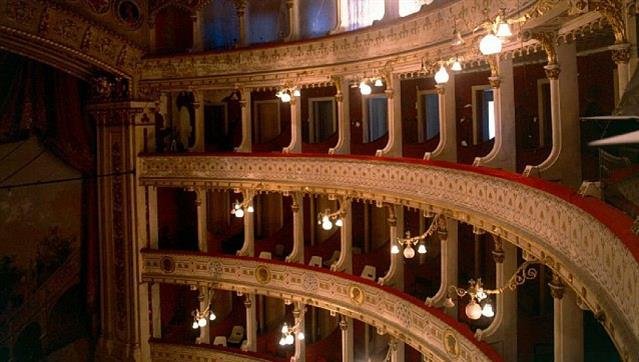
A house built to see and be seen
Discover Garcia de Resende Theatre
Ramalho Perdigão's initiative laid the foundation stone in 1881.
Management and conservation
Centro Dramático de Évora (CENDREV) manages the theatre. Check its programme to distinguish public visits from rehearsals and performances.
How to plan your visit
Allow for the scheduled session if going inside. The square also makes a short stop between Giraldo and the upper town.
Why this place stands out
- From the stalls, the tiers of boxes frame the audience as part of the spectacle.
- Scenic artist Luigi Manini contributed to the painted stage curtain.
Place facts and transport
- Place
- Garcia de Resende Theatre
- Location
- Praça Joaquim António de Aguiar, Évora, Portugal
- Suggested duration
- Allow for the scheduled session if going inside. The square also makes a short stop between Giraldo and the upper town.
- Opening and entry
- Check the scheduled session with the organiser.
Opening hours and access
Check the scheduled session with the organiser.
Tickets and prices
Ask the organiser for the price of the specific session.
Getting here
Walking in the old town
Praça Joaquim António de Aguiar, Évora, Portugal
Driving and parking
The old town has narrow streets and driving restrictions. Check authorised public parking areas and complete the approach on foot.
Public transport
Use regional services to Évora, check current timetables and connections, and walk the final stretch to the monument.
Heritage and cultural context
The Barahona family carried the work forward after his death. The Lisbon company from Teatro D. Maria II opened the stage in 1892, giving Évora a venue for touring productions.
From the stalls, the tiers of boxes frame the audience as part of the spectacle. Scenic artist Luigi Manini contributed to the painted stage curtain.
Before you enter
Photograph from permitted spaces and ask before photographing interiors.
Check the scheduled session with the organiser.
Getting here
The historic centre is best explored on foot. Narrow lanes, old paving and traffic restrictions make it useful to confirm the pedestrian approach on the map. Check transport services for longer journeys to Évora.
Praça Joaquim António de Aguiar, Évora, Portugal
Visitor ratings and reviews
Explore recent visitor ratings and experiences for this monument on Google Maps.
View current Google Maps reviews ↗Where to stay for this area
For a walking itinerary, consider accommodation in Évora’s historic centre or near pedestrian access points. Check the actual walking distance and parking conditions if arriving by car.
History
The Barahona family carried the work forward after his death. The Lisbon company from Teatro D. Maria II opened the stage in 1892, giving Évora a venue for touring productions.
Architecture and setting
From the stalls, the tiers of boxes frame the audience as part of the spectacle. Scenic artist Luigi Manini contributed to the painted stage curtain.
What to look for
- From the stalls, the tiers of boxes frame the audience as part of the spectacle.
- Scenic artist Luigi Manini contributed to the painted stage curtain.
Practical information
Location and access
Praça Joaquim António de Aguiar, Évora, Portugal
Opening and access
Check the scheduled session with the organiser.
Tickets and prices
Ask the organiser for the price of the specific session.
Visit duration and advice
Allow for the scheduled session if going inside. The square also makes a short stop between Giraldo and the upper town.
Suggested walking route
- 1
Walk from Praça do Giraldo up Rua Nova to the theatre square.
- 2
Follow the frontage to the box office and check whether your performance or visit includes the auditorium.
Photography and responsible visiting
Photograph from permitted spaces and ask before photographing interiors.
Frequently asked questions
Does an open box office mean I can enter the hall?
Ask at the box office first. Ticket sales can take place while the auditorium is closed.
Where should I start the walk?
Walk from Praça do Giraldo up Rua Nova to the theatre square.
What deserves a closer look?
From the stalls, the tiers of boxes frame the audience as part of the spectacle. Scenic artist Luigi Manini contributed to the painted stage curtain.
Map and sources
Praça Joaquim António de Aguiar, Évora, Portugal
Keep exploring Évora
Roman Baths of Évora
Ancient public baths beneath the Town Hall
Church of Saint Vincent, Évora
A neighbourhood church linked to the tradition of Évora’s martyrs
Évora Public Garden
Romantic landscaped walks and historic follies
Portas de Moura Fountain
A Mannerist fountain in Évora’s historic streets
Church of the Holy Spirit of Évora
A Mannerist church with Jesuit architectural roots
Palace of the Dukes of Cadaval
Noble residence and medieval towers beside the Roman Temple
Church of Mercy of Évora
Narrative tiles and gilded Baroque carving
Chapel of Saint Blaise
Late Gothic chapel beyond Évora’s medieval walls
Church of Our Lady of Grace
A distinctive Renaissance façade in Évora
Church of the Lóios (Saint John the Evangelist)
Gothic-Manueline details and historic tile panels
College of the Holy Spirit
Historic university cloisters in Évora
Roman Temple of Évora
Corinthian columns above the historic city
Évora Cathedral
A fortified medieval cathedral above the old town
Água de Prata Aqueduct
Renaissance water engineering across Évora
Walls of Évora
Defensive layers around the historic centre
Praça do Giraldo
Évora’s central square and civic meeting place
Chapel of Bones
A powerful reflection on mortality
Church of São Francisco
A monumental church adjoining the Chapel of Bones
Palace of Dom Manuel
Royal history within Évora’s public garden
National Museum Frei Manuel do Cenáculo
Art and archaeology beside the Roman Temple
Church of Santo Antão
The church facing Praça do Giraldo
Clock Museum, Évora branch
A collection that started with three stopped watches
Évora Public Library
An archbishop’s collection beside the Roman temple
Barahona Palace
A nineteenth-century home adapted for the courts
Santa Clara Church and Convent
From enclosure to classroom
Church of Salvador do Mundo
Reading a convent from its fragments
Church of São Tiago
A mounted saint above the portal
São Mamede Church
A painted vault beside the old Mouraria
Remédios Convent
Music and archaeology beyond the walls
Almendres stone enclosure
Reading the arrangement of stones on a slope